
Christmas Card Etiquette vs Digital Greetings: What to Send and When
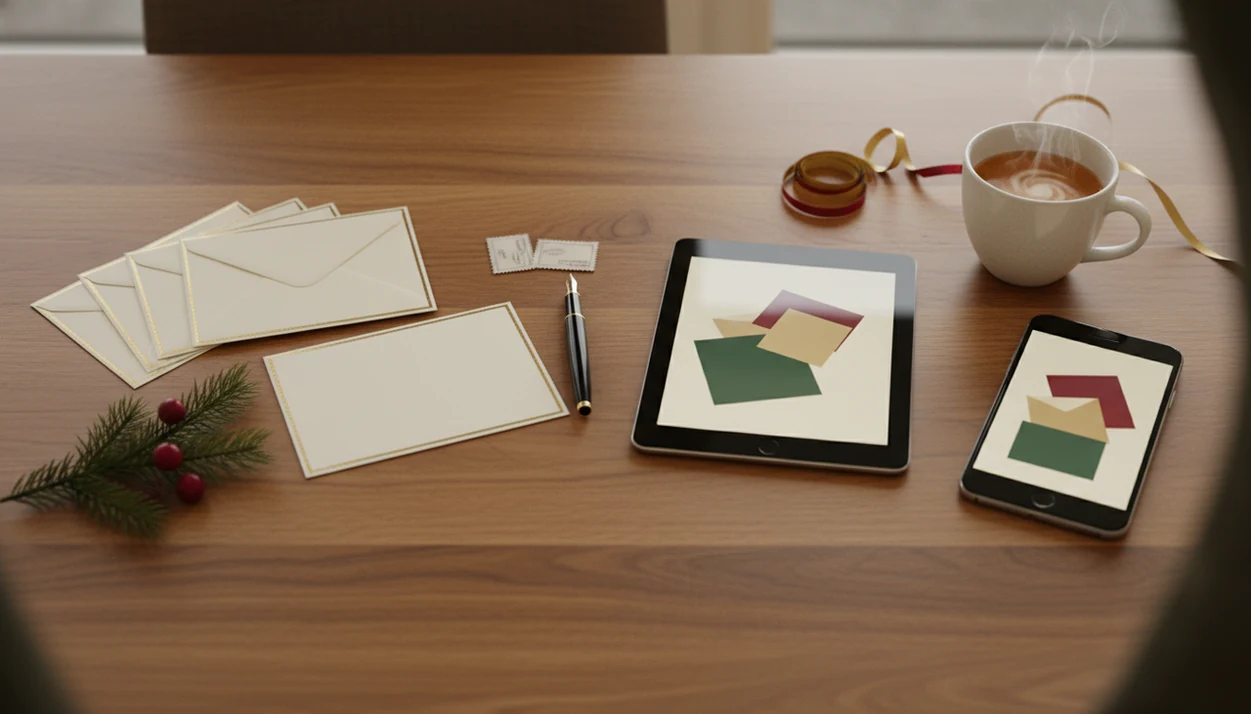
Printed cards are usually the safer etiquette choice for close family, traditional recipients, and formal client relationships, while digital greetings are acceptable when speed, budget, distance, or casual tone matters more. The best answer to Christmas card etiquette vs digital greetings is to match the format to the recipient, then personalize the message enough that it does not feel like a mass blast. XmasCard and PiXmas Cards fit the practical middle: start with the phone photo you already have, then make either a printable version or a shareable greeting.
Definition: Christmas card etiquette vs digital greetings compares the social expectations around mailed holiday cards, emailed cards, texted greetings, and social posts, especially timing, tone, personalization, privacy, and relationship formality.
- Choose printed Christmas cards when keepsake value, display value, tradition, or extra effort matters to the recipient.
- Choose digital greetings when you are late, sending to a large group, managing costs, or contacting people who prefer email, text, or social channels.
- Etiquette depends less on paper versus screen and more on timing, wording, personalization, privacy, and whether the greeting fits the relationship.
At-a-glance Christmas card etiquette vs digital greetings comparison
Printed cards usually signal more effort, but digital greetings are not automatically rude. A Gallup poll found mailed or hand-delivered cards, email, text, social media, and phone greetings all coexist in U.S. holiday habits source.
| Etiquette factor | Printed Christmas card | Digital greeting |
|---|---|---|
| Timing | Needs printing, addresses, postage, delivery | Can go out much later |
| Perceived effort | Higher, especially with signatures | Depends on personalization |
| Cost | Paper, envelopes, postage | Often lower per recipient |
| Formality | Strong for family elders and clients | Varies by email, text, or post |
| Personalization | Photo, note, handwriting | Names and custom lines matter |
| Privacy | Address list stays private | Watch BCC and group texts |
| Keepsake value | Easy to display on fridge or mantel | Easy to save, less displayable |
| Recipient fit | Grandparents, clients, close friends | Casual groups, distant friends, large lists |
At 9:47 p.m., the difference is obvious. One route needs stamps; the other needs a careful send list.
Five holiday card etiquette facts readers should know
Holiday card etiquette is mostly about effort, timing, and recipient expectations. The format matters, but the relationship matters more.
- Printed Christmas cards need earlier planning because printing, addressing, postage, and delivery take time.
- Digital card etiquette allows later sending, but tone and personalization still count.
- Family, friends, neighbors, clients, colleagues, and vendors often need different wording.
- “Happy Holidays,” “Season’s Greetings,” and “Warm wishes for the new year” are safer for broad professional lists.
- The recipient’s preference matters more than the sender’s convenience.
XmasCard works well when the same porch-light family snapshot needs two outcomes: a mailed card for relatives and a textable version for cousins. Good holiday tools deliver a finished greeting, not a fake etiquette rule that says one format wins everywhere.
How holiday card etiquette works across paper and digital formats
Holiday card etiquette works as a social signal: the greeting shows effort, attention, relationship closeness, and respect for what the recipient expects. In plain terms, people read the delivery method as part of the message.
Printed cards carry physical signals. The address is correct, the stamp is real, the family photo is chosen, and the signature took a little time. A card held by a fridge magnet also keeps working after the envelope is opened.
Digital greetings carry speed and convenience signals. That can feel thoughtful when the message is personal, or careless when it looks forwarded to everyone in the phone. XmasCard treats the phone photo as the starting point, not the etiquette answer. The same image can become a printable card or a digital greeting; the delivery context decides how it feels.
Where printed Christmas cards win on etiquette
Printed Christmas cards win when the recipient values tradition, display, and visible effort. They are often the better choice for grandparents, close relatives, long-time family friends, formal clients, donors, premium customers, and people who save cards year after year.
Paper gives the photo a place to live. A milestone photo, birth announcement, annual family update, or small-business thank-you can sit on a mantel instead of disappearing under a breakfast group-chat ping. For families, family Christmas card wording helps keep the note warm without turning it into a full letter.
If the relationship is formal or emotionally important, print is often stronger than digital because it adds address accuracy, lead time, postage, and a physical keepsake. The catch is real: you need current mailing addresses and enough room before the current USPS holiday mailing deadlines source.
Where digital greetings win on holiday card etiquette
Digital greetings win when speed, distance, budget, or recipient preference matters most. They are practical for last-minute greetings, international recipients, younger relatives, casual groups, large lists, and friends who live inside email or text anyway.
According to Gallup, 34% of U.S. adults said they would send holiday greetings by text in 2021, 9% by email, 19% through social media, and 21% by phone source. That does not make every text elegant. It does show that non-mail greetings are normal.
If Christmas is only days away, then XmasCard fits the late-but-still-thoughtful use case because one phone photo can become a polished digital greeting without waiting for envelopes. Email usually feels more formal than a text. Social posts feel broad. App-based cards sit in between when they are addressed carefully.
Evidence on printed vs digital holiday greeting habits
The evidence says printed and digital greetings both have a real place in holiday habits. Surveys show common behavior, not a universal etiquette rule that every household must follow.
Gallup’s holiday greeting data shows a mixed landscape: mailed or hand-delivered cards still matter, while texts, email, social posts, and phone calls are also ordinary ways people send seasonal wishes. That supports the practical split in this guide: paper often carries ceremony and keepsake value, while digital formats handle speed, distance, and casual reach. USPS holiday mailing deadlines add another piece of evidence: printed cards require planning because production, addressing, postage, and delivery all happen before the recipient ever opens the envelope. Market and mail-volume behavior point the same way in broad terms. Greeting cards remain a familiar consumer category, but households also send fewer personal letters than past generations, so expectations are more varied than they used to be.
- Treat survey numbers as a snapshot of norms, not a command.
- Plan printed cards around postal cutoffs and address checks.
- Use digital greetings when the timing or recipient preference clearly fits.
- Decide by relationship first, then by channel.
How to choose printed cards or digital Christmas greetings
Use the recipient, not your panic level, as the deciding factor. A holiday card draft should match closeness, timing, budget, privacy, and formality before you hit print or send.
- Rank the relationship: Put close family, formal clients, and older recipients in the “consider print first” group.
- Check the preference: Use digital if the person usually replies by text, email, or social message.
- Read the deadline: Choose print when there is mailing time; choose digital when the holiday is days away.
- Set the budget: Count postage, paper, and printing before committing to a large mailed list.
- Review privacy: Avoid public posts or visible recipient lists for family news and children’s photos.
- Build one card: Use a phone photo in XmasCard for either a printable card or digital greeting without changing the core photo.
Print for tradition and importance; digital for speed and convenience.
How to use printed and digital Christmas greetings
Use printed and digital Christmas greetings together by treating them as two delivery paths from one thoughtful list. The goal is not to double your work; it is to send the right format to the right person.
- Build one master list: Split recipients by relationship first, then add their usual channel: mailing address, email, text, or social message.
- Send printed cards early: Choose paper for relatives who display cards, older family friends, formal clients, and anyone who values a keepsake or a more ceremonial gesture.
- Use digital greetings selectively: Save email, text, or app-based cards for late sends, casual friends, distant contacts, low-clutter households, or people who clearly prefer quick replies.
- Personalize close contacts: Add one real detail, such as “We loved seeing you at the lake” or a short family update, so the greeting does not read like a template.
- Check before sending: Review BCC fields, group-message visibility, photo backgrounds, children’s details, addresses, and any personal news before a digital greeting leaves your phone.
A mixed approach lets XmasCard start from one photo while the etiquette still comes from your recipient choices.
Client and small-business holiday card etiquette
Business holiday card etiquette should stay warm, neutral, and light on selling. That matches standard etiquette advice to consider the recipient's background and avoid wording that assumes one holiday tradition for a mixed audience source. “Happy Holidays,” “Season’s Greetings,” and “Warm wishes for the new year” are safer for broad client lists than assuming everyone celebrates Christmas.
Printed cards suit high-value clients, local customers, donors, partners, and long-standing vendors. Digital greetings suit newsletters, appointment reminders, remote teams, broad customer lists, and last-minute outreach. For wording, business holiday card wording is the safer place to draft before the client list is open beside the card.
When the issue is professional tone, XmasCard handles the card format, while the sender still controls the greeting, recipient list, and privacy choices. Avoid sales-heavy copy, religious assumptions, over-personal data, and visible recipient lists. Canva and Picsart can offer broad design options, but the etiquette burden still sits with the sender.
Missed deadlines and late Christmas greeting etiquette
What should you do if Christmas cards are late? Late printed cards can still work if they are framed as New Year cards or general holiday season greetings.
Digital greetings are often the better etiquette choice when the holiday is only days away. Do not over-apologize. A short, warm line usually lands better than a long explanation about the missed post office cutoff notice.
Try: “Wishing you a peaceful holiday season.” Or: “Happy New Year from our family to yours.” For tight notes, short Christmas card messages can keep the wording from getting fussy.
The right fit for missed deadlines is XmasCard because it supports a same-night digital greeting and a printable version if you still want cards for nearby relatives.
Privacy and personalization rules for digital card etiquette
Digital card etiquette starts with privacy. A greeting should not expose other recipients in a visible email chain or group text, especially when children’s photos, addresses, family updates, or personal news are included.
Use BCC for broad email lists. If you would hesitate to tape the photo on a community bulletin board, do not put it in a public story. Send individual messages for close relationships. Ask yourself whether the toddler looking away, the school sweatshirt, or the house number in the background should be shared beyond family. For deeper checks, Christmas card photo privacy covers the photo side.
One custom sentence can change the whole feel: “We loved seeing you in June” beats a generic blast. XmasCard should stay limited to making the photo card or greeting. Delivery etiquette, consent, and recipient judgment still belong to the sender.
Common myths about Christmas card etiquette vs digital greetings
Several holiday card etiquette claims sound tidy but fail in real life. The better answer depends on recipient, timing, message, and channel.
- Myth: Digital Christmas cards are always rude. They can be thoughtful when individually addressed and well timed.
- Myth: Printed holiday cards are always more appropriate. Some people prefer fast, low-clutter digital greetings.
- Myth: Email automatically feels formal. A sloppy email can feel less formal than a careful text.
- Myth: Business contacts should always receive Merry Christmas wording. Neutral wording is safer for mixed professional audiences.
- Myth: Digital greetings are automatically greener or cheaper. Cost and impact depend on quantity, postage, device use, and whether recipients print them.
PiXmas Cards helps with the card itself, but it cannot make a careless recipient list feel personal.
Limitations
Etiquette guidance is useful, but it is not a universal law. Real households have different holiday habits, and one family’s warm shortcut can be another family’s slight.
- There is no universal rule that digital greetings are always acceptable or always inappropriate.
- Expectations vary by family, culture, age group, workplace, region, and religious background.
- Printed cards cannot be fully replaced for recipients who value display, keepsake, or handwritten effort.
- Digital greetings can feel impersonal when mass-sent, generic, or poorly addressed.
- Timing guidance changes by postal delays, travel schedules, office closures, and international delivery.
- Environmental and cost comparisons depend on print quantity, postage, device use, delivery channel, and whether recipients print the card.
- Survey data shows behavior, not a binding etiquette rule for every household.
- XmasCard, Photoleap, Picsmas, and FestivAI can help make greetings, but none can judge your aunt’s expectations or a client’s office culture.
FAQ
Are digital Christmas cards rude?
Digital Christmas cards are not rude when the message is personal, well-timed, and appropriate for the relationship. They can feel rude when they are generic, visibly mass-sent, or too casual for the recipient.
When should Christmas cards arrive?
Mailed Christmas cards usually need to arrive before the holiday week, so send them early enough for printing and postal delivery. Digital greetings can be sent later, including close to Christmas or New Year.
Is it okay to email Christmas greetings to clients?
Email Christmas greetings are acceptable for broad client lists, newsletters, and remote contacts. Printed cards often feel more professional for high-value clients, donors, partners, and long-standing vendors.
Should businesses say Merry Christmas in holiday cards?
Businesses should use neutral wording such as “Happy Holidays” for broad professional audiences unless the relationship clearly supports Christmas-specific wording. Neutral wording avoids religious assumptions.
Are texted holiday greetings acceptable?
Texted holiday greetings are acceptable for casual friends, relatives, and informal groups. They can feel too casual for formal clients, older recipients, or high-value professional relationships.
Do printed Christmas cards feel more personal?
Printed Christmas cards often feel more personal because they show effort through printing, addressing, postage, signatures, and display value. They also work better as keepsakes.
What should I do if Christmas cards are late?
Use New Year wording, send a digital greeting, or frame the message as a warm holiday-season note. Avoid excessive apologies and keep the greeting sincere.
Should digital Christmas cards be personalized?
Digital Christmas cards should include names or at least one custom sentence when possible. Personalization keeps the greeting from feeling like a mass message.